
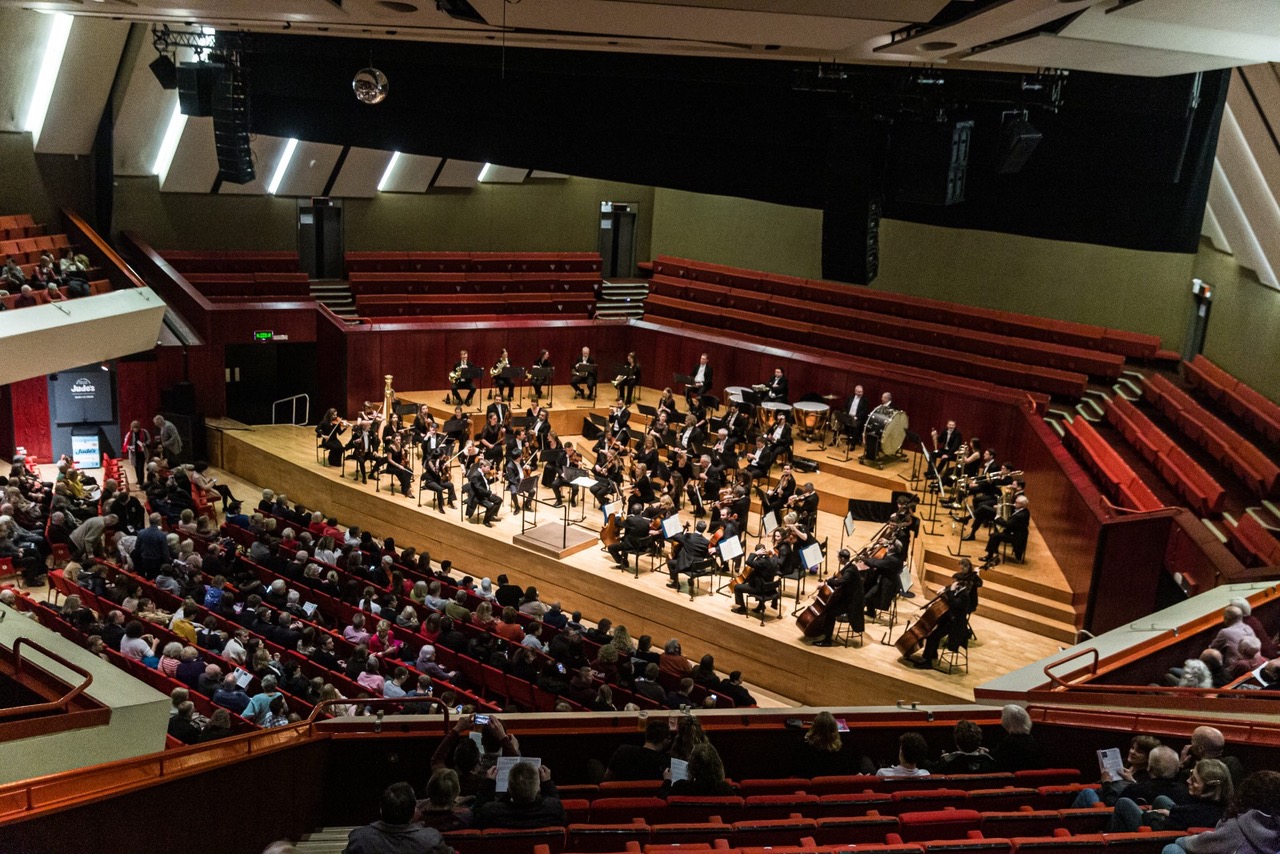
Orchestral music is increasingly becoming part of everyday life in and around Reading, with people across the region turning to it on holiday, on their commute and during quieter moments at home, according to new research from the Royal Philharmonic Orchestra (RPO).
Findings from this year’s annual audience trends report by the RPO shows that 85% of adults in Berkshire and Surrey feel they have a relationship with orchestral music. The findings suggest that residents in these counties have a strong connection to the orchestral genre, which is not confined to the concert hall but is also becoming part of people’s daily routines and habits.
The Royal Philharmonic Orchestra tours widely across the UK and, ahead of it returning to The Hexagon, Reading, as part of its new concert season for 2025-6, the Orchestra commissioned audience research to understand how music tastes and engagement vary across the UK.
There is a strong local connection to orchestral music across Berkshire and Surrey, with 85% of people saying they have some relationship with the genre. Of these, 30% say they have enjoyed it for many years, 14% say they are on a journey of discovery and 13% say they are engaging with orchestral music for the first time.
The counties also stand out for the way people are incorporating orchestral music into daily life. For many, it has become part of the soundtrack to holidays and travel, while others turn to it while commuting, reading or relaxing at home.
There is a strong connection to the piano and to core classical repertoire. Beethoven is the most popular composer, while Chopin is more popular here than anywhere else in England. It is also the part of the UK where children are most likely to choose the piano when learning an instrument.

Sarah Bardwell, Managing Director of the Royal Philharmonic Orchestra, said: “At the RPO we are proud of our long-standing association with The Hexagon and we are excited to return to Reading for our new concert season for 2026-7, which will be announced next month. Ahead of that our new research shows that orchestral music is not something people only engage with in formal settings. In Berkshire and Surrey, it is becoming part of everyday life, from holidays and commuting to reading, relaxing and discovering new sounds through television and film. That matters because it shows how people are building a real relationship with the genre on their own terms. For orchestras and venues alike, that is an important reminder that audience growth does not start at the concert hall door. It starts much earlier, in people’s daily routines, habits and curiosities.”
Other findings include:
· People in Berkshire and Surrey are more likely than others to listen to orchestral music while reading.
· The TV programmes most likely to have inspired audiences to discover orchestral music include Planet Earth and Poldark.
· Just 8% of respondents say they have poor access to the arts, the lowest figure of any UK region surveyed.
The research also points to strong local pride in musical life.
|
What people value about the local music scene |
% |
|
Diversity of music styles celebrated locally |
45% |
|
Quality of music venues |
42% |
|
Strength of grassroots music scene |
38% |
|
Being on the touring circuit for major artists and bands |
35% |
Cllr Adele Barnett-Ward, Lead Councillor for Leisure and Culture, said: “This research reflects something we see locally, which is that live music continues to matter deeply to audiences, even as the ways people discover and enjoy it keep changing. It is encouraging to see such a strong connection with orchestral music locally, and we are proud to work with the RPO to bring high-quality live performance to audiences at The Hexagon.”
Alongside long-term audience trends, the RPO’s annual report also includes newly commissioned national polling on public attitudes to artificial intelligence in music. The findings show a clear distinction in how audiences view different uses of AI:
· 78% of UK adults believe AI will not replace live music performance;
· 50% believe studio-recorded music could be partially replaced by AI in the coming decades;
· The most frequently cited concerns relate to artists’ livelihoods, royalties and the future of local music venues.
While respondents recognise potential benefits for AI in areas such as restoration, mixing and production, there is strong resistance to its use where it interferes with human creativity, emotional expression or the shared experience of live performance.
Reflecting on the RPO’s new research on AI in Music, Vasily Petrenko Music Director of the Royal Philharmonic Orchestra adds: “In many ways, human creativity and AI can co-exist because they offer different strengths. The RPO research revealed that the public felt AI could be used successfully to enhance the production side of recording music – such as the mastering of new recorded music and the restoration and audio enhancement of archive recordings. In terms of the creation of music, AI may in theory offer perfection, but great art is often art precisely because of human imperfections implicit within the shape and form of the piece. This is true of many great paintings for example. Any creative act – any art – always has an element of hesitation in the mind of an artist. Not hesitation in the exact moment of creation, but about the ‘fullness’ or ‘completion’ of the object. One of many examples might be the Unfinished Symphony by Schubert. This kind of hesitation is completely beyond AI, in terms of structure and idea. This adds weight to the thought that change and continuity can co-exist.”